Measure the whole movement
A product can look impressively small in its storage photograph and still be awkward in an actual home. The missing measurement is often the sweep: the space a moving part needs while it opens. A folding table may need clear floor beside it. A wall bed needs an unobstructed arc. A nesting stack may require enough overhead clearance to lift out the largest bowl.
Start with three states: stored, moving and working. Measure each one, then include the person using it. A useful space-saving design does not simply shrink an object. It makes those states easy to reach without moving half the room first. Count the repeated actions, too. A daily conversion has a different cost from folding spare chairs after an occasional gathering.
Folding: let geometry do the packing
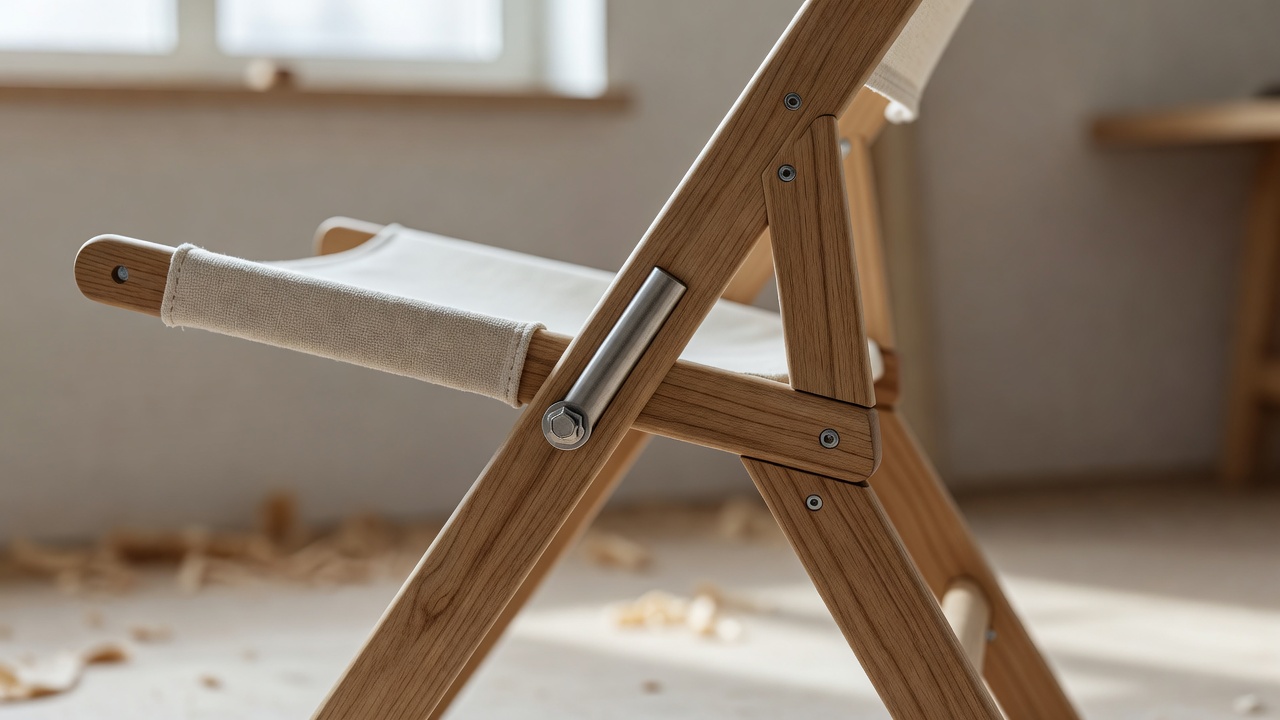
A folding chair brings rigid parts closer together by allowing rotation at selected joints. The hinge supplies movement; the open geometry, stops and any locking features establish the usable position. Those roles should not be confused. A freely moving pivot is not automatically a secure support.
Look at where the seated load travels. Ideally, substantial frame members carry it through predictable contact points. If a tiny latch becomes the only thing preventing collapse, that component deserves particular attention. Wear can change clearances, introduce wobble or interfere with engagement. Pinch points also appear where two parts approach each other during folding.
Michael Thonet’s No. 14 chair, introduced in 1859, offers a useful historical contrast. It is not a folding chair. Its bentwood components and knock-down construction instead made manufacture and transport more efficient. Saving shipping volume and saving everyday floor space are related goals, but they are not the same problem.
Nesting: share the empty middle
Bowls, measuring cups and some stools exploit unused interior volume. Taper lets one object sit inside another, reducing the combined storage envelope. The clever part is often a small detail: a rim that remains accessible, a clearance that avoids wedging, or a spacer that prevents broad surfaces from sticking together.
The compromise is retrieval. If your everyday bowl sits underneath four others, the stack saves cupboard space by spending your time. Similar-looking pieces can also be difficult to distinguish. Wet nested containers may dry poorly. Think about the frequency of access and the drying routine before treating a tidy stack as a complete solution.
Stacking is different from nesting. Stacked objects may remain largely outside one another and rely on locating features for stability. Nesting usually overlaps more of their volume. Both can work well, but neither guarantees a stable tower or easy one-handed removal.
Transformation: two jobs, one footprint
Wall beds, extendable tables and convertible seats assign different jobs to the same area at different times. William Lawrence Murphy’s early twentieth-century bed patents are part of the documented history of beds that disappear into cabinetry. Modern wall beds vary considerably in their lifting, balancing and restraint systems.
A spring or gas strut can offset some lifting effort, but it does not remove the need for correct installation. Anchoring, clearances and safe operation must follow the specific manufacturer’s instructions. Do not improvise a load-bearing installation from a general design article. The same caution applies to heavy fold-down desks and wall-mounted storage.
Ask what must move before the transformation begins. Bedding, cables, a rug or the contents of a desk may turn a promising mechanism into a chore. The strongest design often preserves useful things in place rather than merely adding another mode.
Read the trade-off, not the silhouette
| Strategy | What it saves | What to inspect |
|---|---|---|
| Folding | Idle floor area or depth | Pinch points, locks, opening sweep |
| Nesting | Unused interior volume | Retrieval order, release, drying |
| Transforming | Separate footprints for separate tasks | Setup effort, anchoring, displaced belongings |
There is no universal winner. A simple hook that stores an ordinary chair might suit a room better than an elaborate convertible object. Choose the smallest total burden, not the smallest folded photograph.
Follow the history
For collection records and historical context, explore the Victoria and Albert Museum and Thonet. Original patent documents can be searched through Google Patents; search by inventor and examine the drawings rather than relying on a product nickname.