Read an object from input to output
Begin where the person touches the object. Do they push, squeeze, turn or pull? Follow that movement through the connected parts. A pivot changes the direction of motion. A gear pair changes rotational speed and torque. A spring stores energy for later release. A stop prevents a part from moving beyond a useful position.
Then identify the constraint. Useful movement depends as much on what cannot move as on what can. A screwdriver handle would be pointless if the shaft slipped freely inside it. A folding joint needs a stable working position. A well-explained mechanism makes both the intended motion and the restrained motion visible.
The clothespin: a reusable squeeze
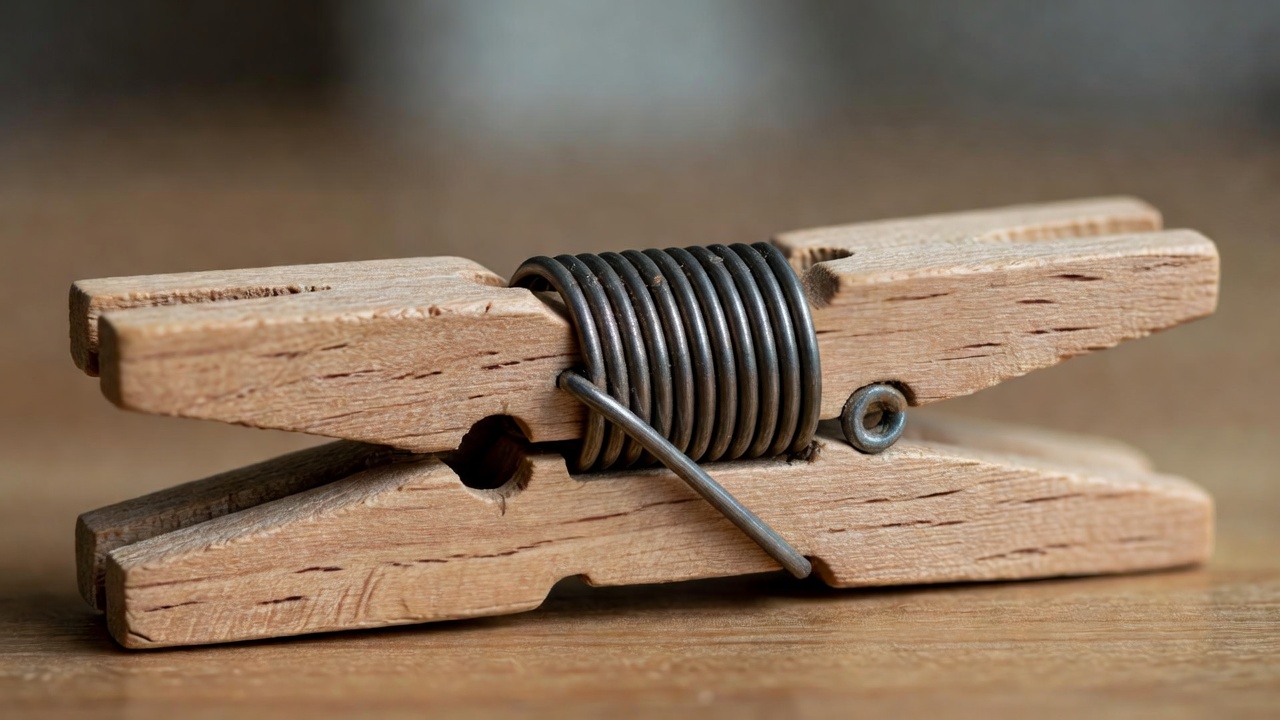
A familiar spring clothespin consists of two shaped arms and a metal spring. When you squeeze the handle ends together, the arms rotate near the spring assembly and the jaws separate. Releasing your fingers allows the spring to close the jaws. The spring supplies the closing action; friction and the jaw geometry help resist the fabric being pulled out.
The grip is not unlimited. Thick material changes the opening angle. Smooth or wet surfaces can change friction. Weather, corrosion and damaged wood affect performance. Making the spring stronger could improve holding force in some circumstances, but it also increases the force needed to open the pin. That is a design trade, not a missing feature.
One-piece wooden pegs solve a related task differently, using their shape and elastic deformation rather than the familiar assembled spring mechanism. Comparing the two shows why a product category can contain several mechanically distinct solutions.
Levers: less force, more travel
A lever rotates around a fulcrum. In a simplified, slowly moving system, the turning effect depends on the applied force and its perpendicular distance from that pivot. Apply the force farther away and you can produce the same turning effect with less force. In exchange, the point where your hand acts travels farther.
That bargain appears in bottle openers, scissors and many gripping tools. Real devices also involve friction, flexing parts and changing contact geometry. A longer handle is not a universal improvement: it takes more space, can be harder to control, and may overload another component. Extension bars should not be improvised on tools that were not designed for them.
Ratchets add a different convenience. A pawl and toothed wheel can permit movement in one direction while resisting it in the other. This allows repeated short working strokes without completely releasing the tool. Tooth engagement, wear and permitted load matter more than the satisfying click.
The salad spinner: let water leave
A salad spinner removes some surface water without asking you to dry each leaf individually. You supply energy through a crank, pull cord or push mechanism, depending on the model. The drive accelerates a perforated basket inside an outer bowl.
The basket turns the leaves. Water droplets that detach continue approximately along their instantaneous direction of motion rather than following the same circular path. They pass through openings and meet the outer bowl. From the rotating basket’s frame, the familiar explanation uses an outward centrifugal effect; from a stationary frame, the key is that detached droplets are no longer constrained to follow the basket’s circle.
Balance matters. An uneven load can create vibration. A brake is a separate mechanism that dissipates rotational energy to slow the basket. The best spinner is not necessarily the fastest: stability, drainage, easy disassembly for washing and sensible storage all affect the real chore.
Useful complexity has to earn its place
| Mechanism | Useful change | Compromise to check |
|---|---|---|
| Spring clamp | Returns automatically to grip | Opening effort and limited grip |
| Lever | Trades travel for force | Clearance and component stress |
| Ratchet | Works through repeated short strokes | Engagement, wear and cleaning |
| Spinning basket | Separates water from leaves | Bulk, balance and washing |
A mechanism earns its parts when it reduces the burden of the complete task reliably. Check what happens when it is dirty, slightly misaligned or used by a different person. A beautiful movement is a fine starting point. A useful object has to keep working after the demonstration ends.
Explore the principles
OpenStax science textbooks explain torque, rotational motion and energy. Science Museum Group collections provide historical examples of mechanisms in manufactured objects. These references explain principles; they do not establish the safety or performance of a particular product.